



Mealtimes are often portrayed as warm family moments, but for many families they can feel stressful, especially when a child struggles with eating. If your child eats only a small range of foods, refuses unfamiliar foods, or experiences distress during meals, you may have heard the terms ARFID or PFD.
Avoidant/Restrictive Food Intake Disorder (ARFID) is an eating disorder in which a child avoids foods or eats a small range of foods due to sensory sensitivities, fear of negative experiences (such as choking or vomiting), and/or a lack of interest in eating. Unlike other eating disorders, ARFID is not driven by concerns about weight, body shape, or body image. Children with ARFID might have these concerns, but the primary motivation behind their food restriction is sensory, fear, and/or lack of interest related.
Pediatric Feeding Disorder (PFD) is diagnosed when a child has difficulty with eating and drinking enough or safely for at least two weeks. To get a diagnosis of PFD, a child must experience challenges in at least one of these four areas:
At Parkwood Clinic, our speech-language pathologists are trained to help children with ARFID and PFD through feeding therapy. Feeding therapy focuses on helping children build safe, positive experiences with a variety of foods while developing the skills needed for eating.
A key part of feeding therapy is parent coaching. Parents and caregivers play an essential role in shaping a child’s mealtime environment, and the language used during meals can make a significant difference. Many well-intentioned phrases that adults use, often out of concern or frustration, can unintentionally increase pressure, anxiety, or resistance around food.
During feeding therapy, parents learn practical strategies for creating supportive mealtimes. Part of that training involves understanding common phrases to avoid during mealtimes, along with more supportive alternatives that help reduce pressure and promote positive feeding experiences. See our examples below:
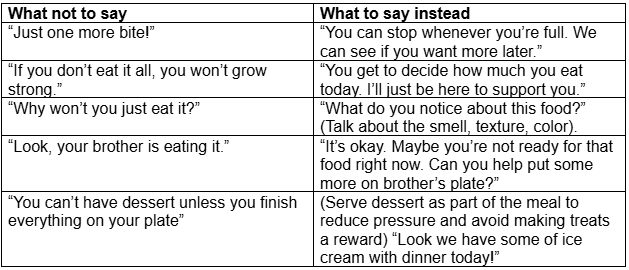
If mealtimes at your home feel like a daily struggle, you are not alone. With the right strategies and support, families can move toward calmer, more positive experiences around food. At Parkwood Clinic, our speech therapists work closely with families to help children develop the skills and confidence they need to eat, explore, and enjoy a wider variety of foods.
References
Barney A, Bruett LD, Forsberg S, Nagata JM. Avoidant Restrictive Food Intake Disorder (ARFID) and Body Image: a case report. J Eat Disord. 2022 May 4;10(1):61. doi: 10.1186/s40337-022-00583-0. PMID: 35509026; PMCID: PMC9069799.
Goday PS, Huh SY, Silverman A, Lukens CT, Dodrill P, Cohen SS, Delaney AL, Feuling MB, Noel RJ, Gisel E, Kenzer A, Kessler DB, Kraus de Camargo O, Browne J, Phalen JA. Pediatric Feeding Disorder: Consensus Definition and Conceptual Framework. J Pediatr Gastroenterol Nutr. 2019 Jan;68(1):124-129. doi: 10.1097/MPG.0000000000002188. PMID: 30358739; PMCID: PMC6314510.
Pergeline H, Gonnet L, Fernandez A, Solla F, Poinso F, Guivarch J. Diagnosis and Treatment of Pediatric Feeding Disorders: A Narrative Literature Review. Children (Basel). 2025 Mar 6;12(3):333. doi: 10.3390/children12030333. PMID: 40150615; PMCID: PMC11941252.


.png)
.png)


.png)